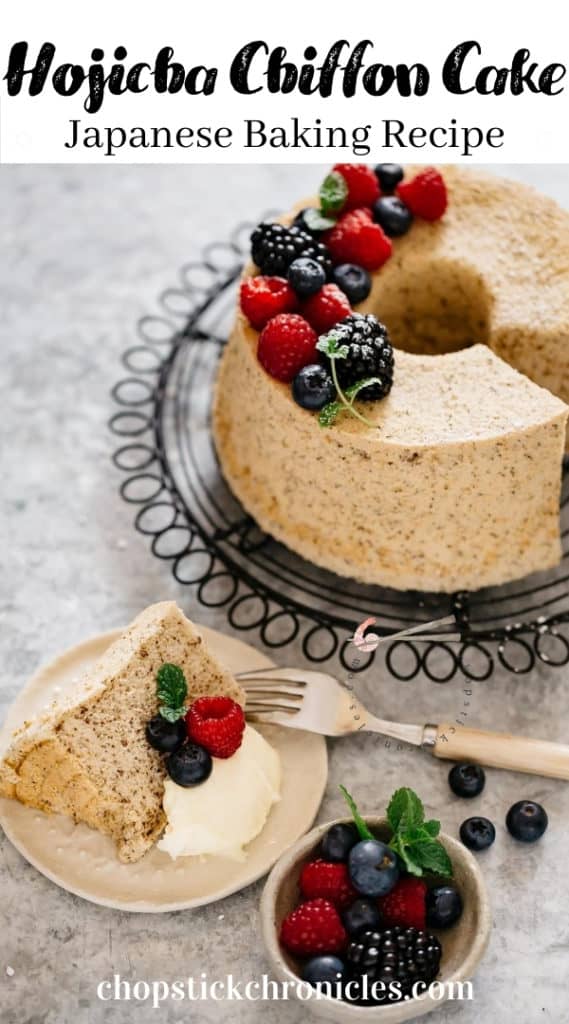
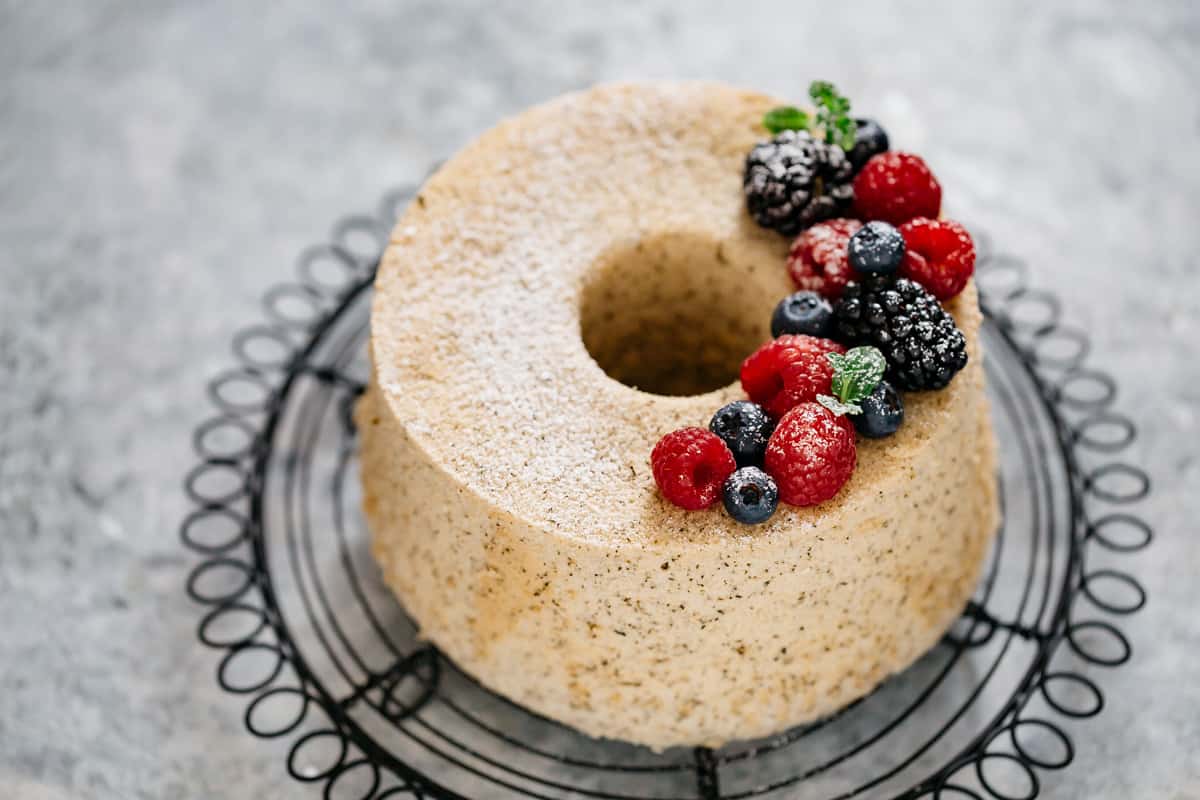
Simple chiffon cake infused with Japanese Hojicha. The cake itself contains hojicha as well and it adds to this simple cake a more roasted flavour. It is very different from English tea leaves infused chiffon cake. Try a new Japanese flavour, you will love this.
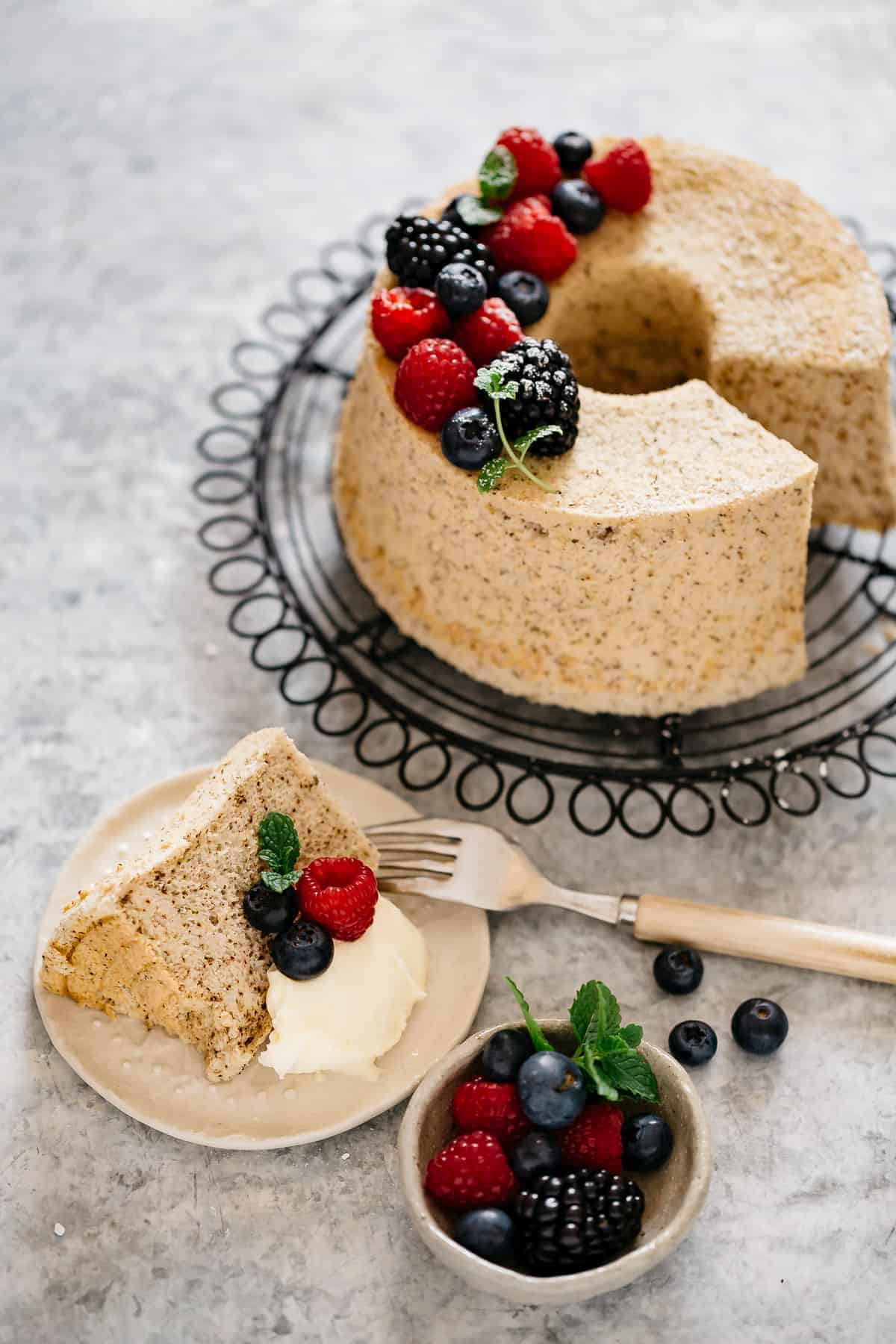
What is Chiffon Cake?
Chiffon is a thin cloth woven from silk. It is a familiar term in fashion such as chiffon scarves and blouses. The chiffon cake has a unique characteristic of cloud-like light and fluffy texture which is as fine as a thin silk fabric like chiffon. This is because the chiffon cake is made of meringue which contains a lot of air. Thus the cake is named after the similar texture of the chiffon fabric.
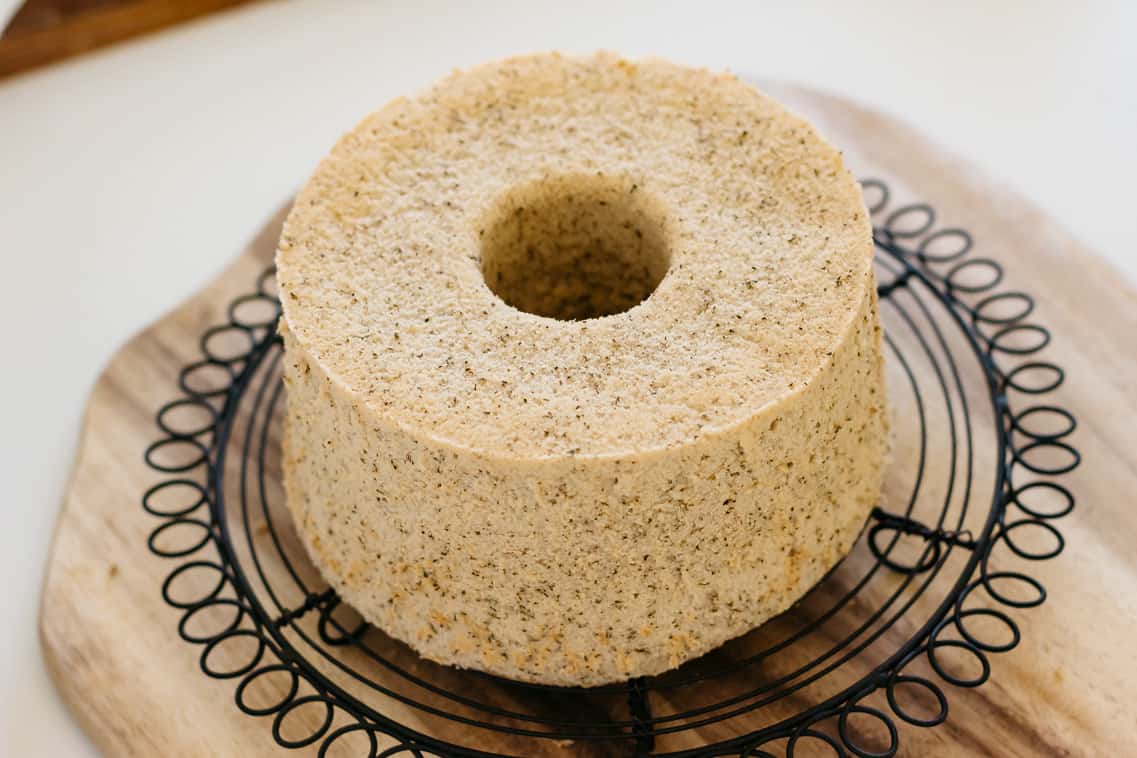
What is the Difference Between Chiffon Cake & Angel Food Cake?
They look similar in appearance however, there are a few differences between them. The first Chiffon cake was made by Mr.Harry Baker in 1927. It was invented based on an “Angel Food Cake” recipe, which is made using only egg white. Chiffon cake recipe calls for both egg whites and egg yolks and also contains vegetable oil. Despite the similarities in appearance, those are the key difference between the cakes.
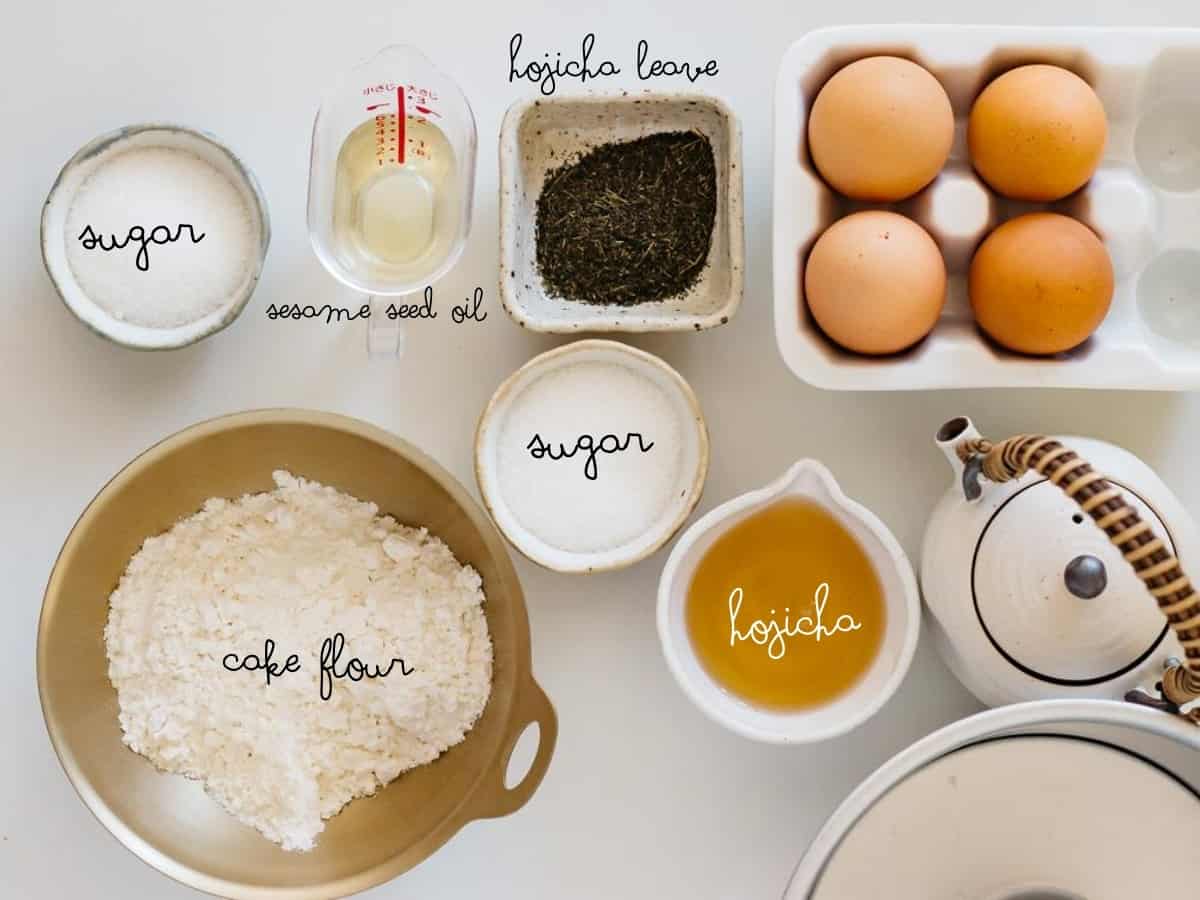
Ingredients to Make Fluffy Texture
- Eggs – I used large size eggs. You need 4 eggs for size 6.7inch (17cm) mould. Separate egg yolks and whites. Egg whites need to be chilled to make the perfect soft peak meringue.
- Sugar – Sometimes people try to reduce the amount of sugar for whatever reasons (mainly health reasons) though do not reduce the amount of sugar for a chiffon cake recipe. Because sugar stabilises the meringue and supports the cake to rise. So reduced sugar is an ingredient for failure.
- Flour – use Cake or pastry flour that contains around 8-9 % protein. You can use all-purpose flour too but the texture will be different.
- Oil – I used sesame seed oil for making dressings, or I usually use rice bran oil. If you can’t access those oils, you can use vegetable oil. Avoid oil that has a strong flavour such as Olive oil. The oil is a key ingredient in creating the chiffon cake signature texture.
- Flavour variations – I used Matcha and Hojicha, however you can use cocoa, or English tea such as earl grey etc. I would like to try Yuzu one day.
Chiffon Cake Texture
Chiffon cake has a distinctive airy fluffy and light soft texture yet the cake is spongy and structured. This texture is the result of using vegetable oil as an ingredient instead of butter in chiffon cake recipes. Because oil has a lower viscosity than butter the fat is spread evenly in the batter which creates the fluffy and soft texture. Also oil has the function to smooth out the gluten that causes the cake batter to inflate in the baking process.
Chiffon Cake Tin & Pallet Knife
The typical chiffon cake has a hole in the middle. That typical shape is made by the chiffon cake mould. Usually, Aluminum Chiffon Cake Mold
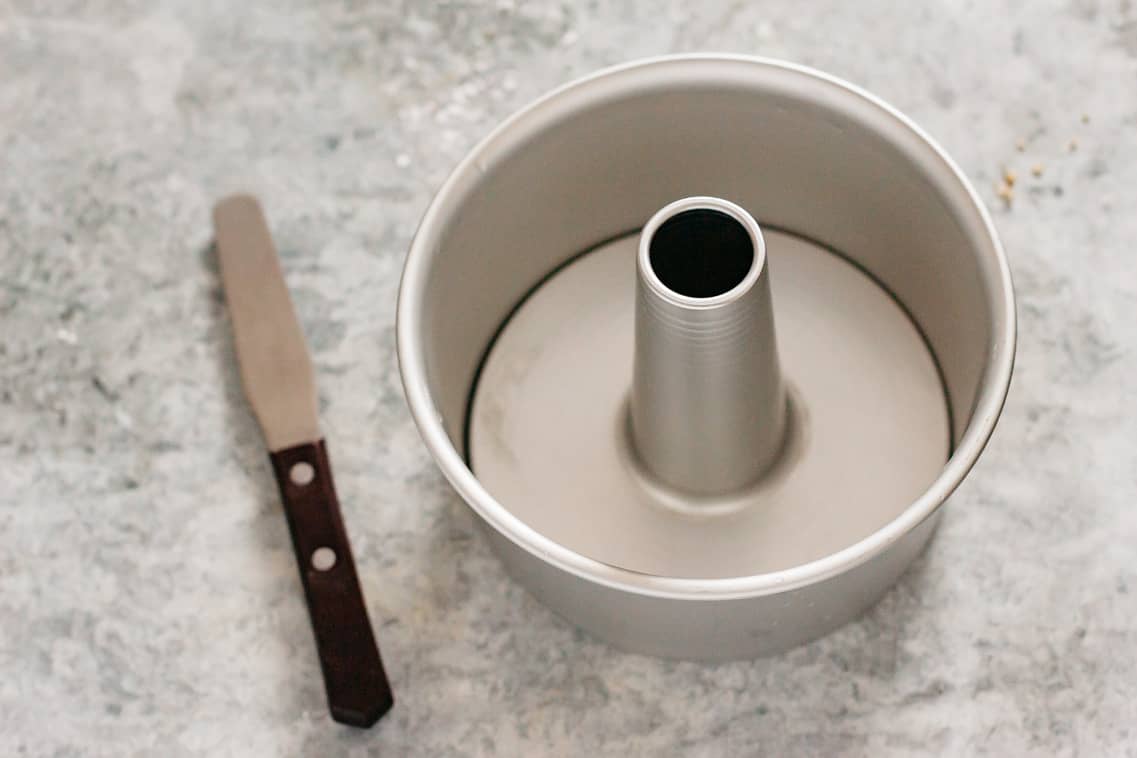
There are many types of chiffon cake tins on the market. My recommendation is tins made from aluminium. There are tins which are teflon coated and made to non stick. They will be easy to remove cake from the tin but the cake needs to stick to the tin in the cooling process. This is the key point to successfully making a chiffon cake. My chiffon cake mold is 6.7 inch (17cm) in diameter.

How to Make Chiffon Cake?
Here is Plain chiffon cake general baking process
- Gather all ingredients and preparation Measure all ingredients precisely as much as you can. I use a kitchen scale for baking for the best result, but if you don’t have one, then read the note section of the recipe card for cup measurements. *Preheat the oven to 356°F (180°C). *Separate the eggs to yolks and whites. Refrigerate the egg white till you whip it. *Sift the flour.
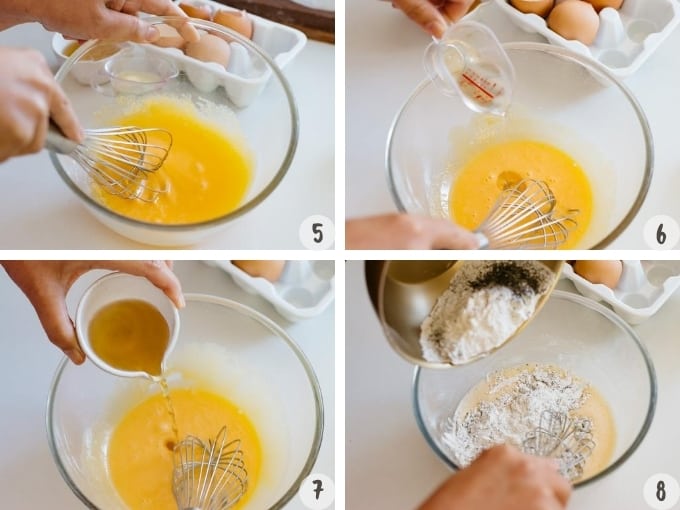
- Make egg yolk cake batter. Add sugar and stir till yolks and sugar combine and sugar dissolved. Then pour oil into the mixture a little bit at a time. Each time you add the oil, keep stirring. When all oil is added and combined, pour milk and combine it all together. Sift the flour into the mixture and stir to combine.
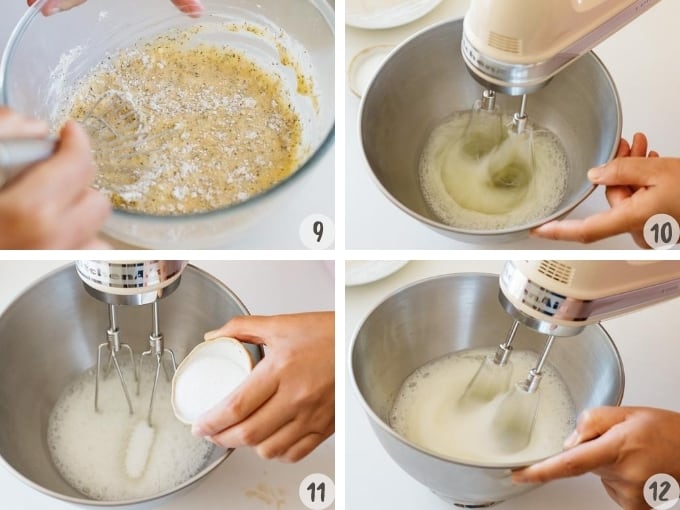
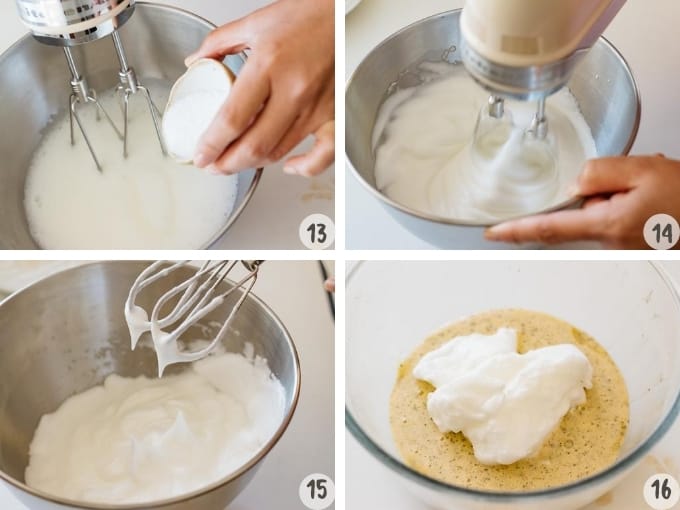
- Whip meringue You can make meringue with a stand mixer, handheld mixer or a good whisk. Beat chilled egg white till large bubbles form. Then add 1/3 sugar at a time to make the meringue. When all sugar is added beat the egg white till it forms a soft peak.
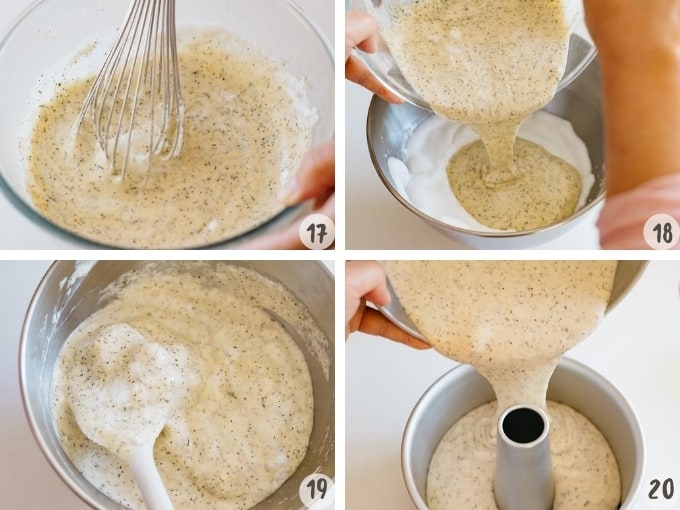
- Combine egg yolk cake batter and meringue Drop a scoop of the meringue into the egg yolk cake batter and combine till you don’t see any streaks of egg white. Then pour the egg yolk batter back into the meringue bowl and fold them all together with a spatula.
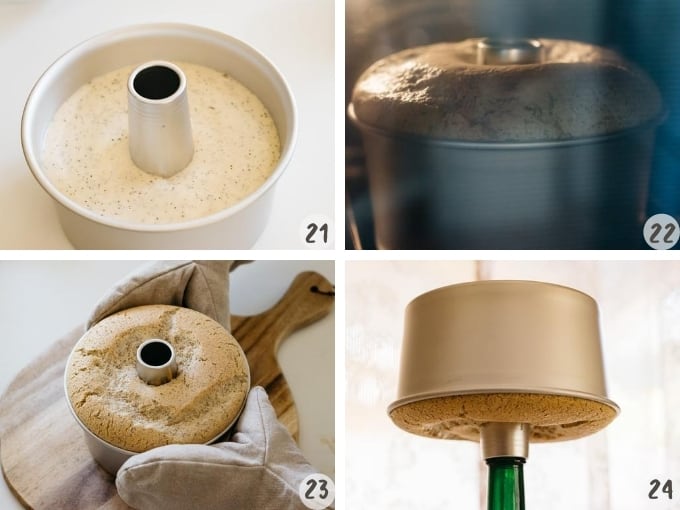
- Bake in the preheated oven Pour the cake batter into a chiffon cake mould. Drop it once onto a kitchen bench to release the air pockets. Then stir the batter with a skewer to pop small bubbles. Bake in preheated oven for 35 minutes.
- Cooldown the cake for about 2 hours Tip Leave the chiffon cake upside down to cool for about 2 hours. We need to put it upside down so that the cake is pulled by gravity and minimise the shrinkage.
- Remove the Chiffon cake out of the mould. Insert a pallet knife between the mould and the chiffon cake and separate the side of the cake from the mould. Do the same for the centre and the bottom.
Tips to Bake Chiffon Cake Successfully
Chiffon cake is not an easy cake to bake, however, if you keep a few steps in mind, you can bake a chiffon cake successfully. Some tips are from my baking club teacher of the high school I once belonged to over 30 something years ago in Japan.
- Each ingredient needs to be measured precisely. If you don’t have a kitchen scale, measure spoon and level with a back of a knife to be as accurate as possible.
- How good the meringue is, determines the result of your chiffon cake. Over and Under beaten meringue is not good. All equipment and tools need to be completely dry, and egg white needs to be chilled until right before the beating.
- Cool the chiffon cake down completely upside down to avoid shrinkage.
- Don’t use a non-stick coating pan.
Trouble Shootings
A: Either the meringue is under beaten or the meringue and egg yolk butter are not combined well. Make sure all pieces of equipment and tools are completely dry. Chill the egg white well prior to making the meringue. Add the sugar at three different times and make the peak soft, not firm. Firm peak meringue is difficult to mix with the egg yolk batter.
It is a natural phenomenon and it is not a problem if it deflates a little bit. There are a few reasons I can think of. One being the amount of cake batter is too much for the mould. Also, the balance of the moisture and flour ratio is not right or the way the meringue and egg yolk batter is mixed. If there is too much moisture, the dry ingredients will exceed the amount that it can support, and if there are too few dry ingredients, it will be insufficient to support the excess moisture. If the meringue and egg yolk batter is not well combined, the leftover meringue will become hollow and it becomes dense after cooling down. So if so, you need to review the balance of dry and wet ingredient and also practice mixing the meringue and egg yolk batter.
The meringue and the egg yolk batter is not mixed well. And for that reason, while the cake is being baked, the meringue part becomes hollow and deflates after the cake has cooled down. To avoid this, the meringue needs to be beaten to form a soft peak, not a firm peak. This is so it is easier to combine with the egg yolk batter. Also after the batter is poured into the mould, drop it down to the kitchen bench and also stir with a skewer to release the air bubbles.
A: If the egg yolk, oil, and water are not emulsified, the water and oil may accumulate at the bottom, which may cause the bottom dent when the cake is removed from the mold. Whisk the egg yolks thoroughly and mix them well in the order of oil and milk to avoid this happening. Also, it may be due to low baking temperature. Check the oven temperature and adjust. reference Danchu
Japanese Variations
The American born Chiffon cake is loved by people all over the world because of its unique airy fluffy texture like a silk woven chiffon fabric. There are many variations in terms of flavours such as vanilla, chocolate, and lemon, etc. I would love to add Japanese flavours to it, Matcha and Hojicha. In the recipe below, I include plain, Hojicha and Matcha.
Serving Suggestions – Japanese Way
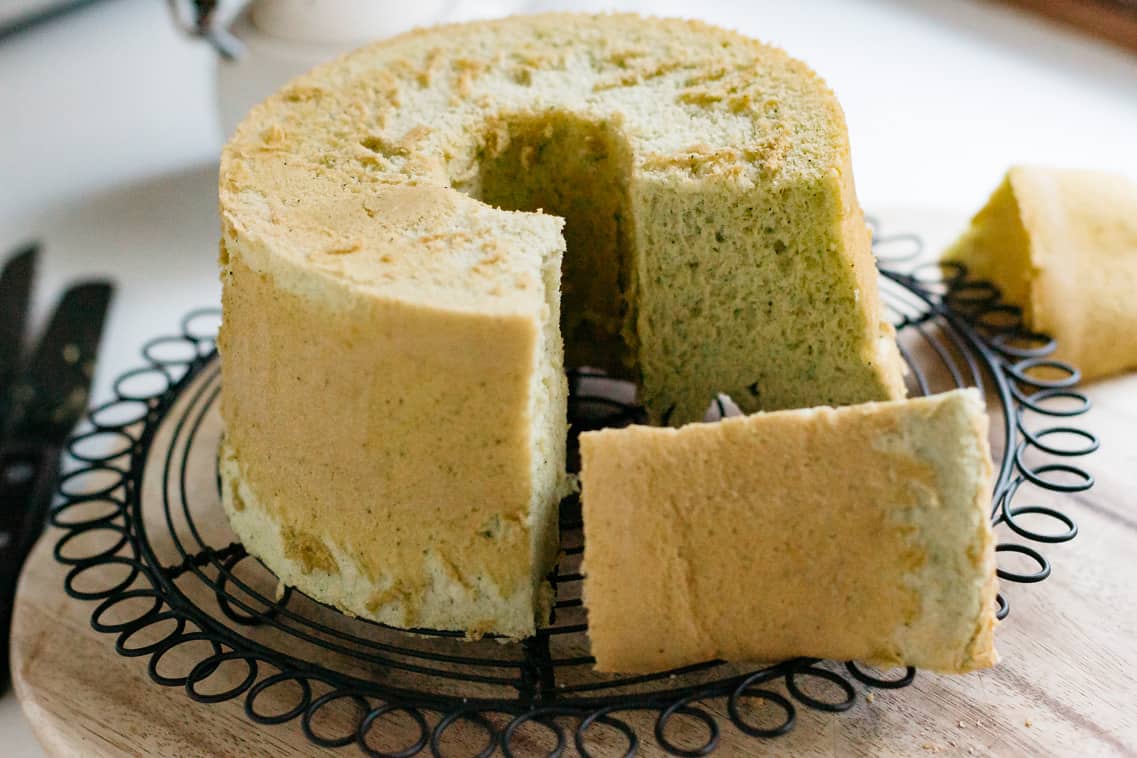
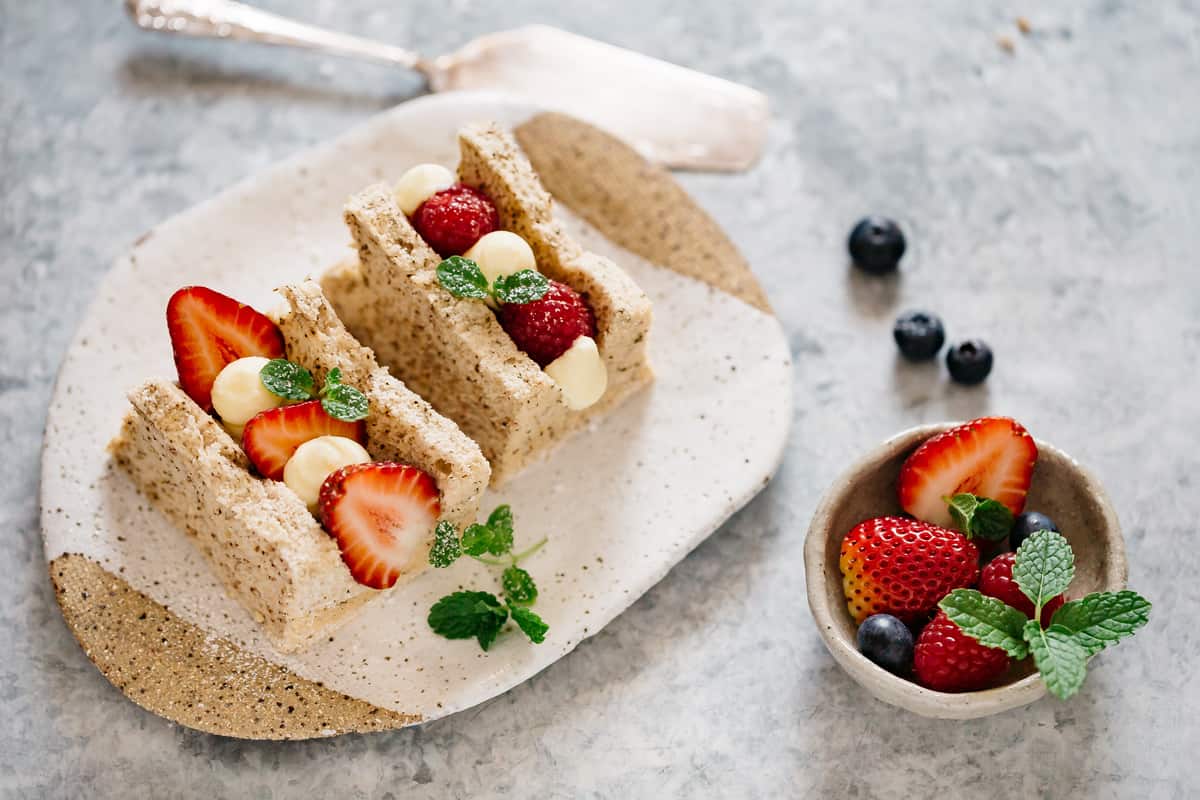
Simple chiffon cakes are served creatively in Japan. Have you eaten or seen Japanese fruit sandwiches, with pillowy soft Japanese milk bread “Shokupan” sandwiches whipped cream and fruit? Just like that, you can make a score into a slice of chiffon cake and decorate with fruit and whipped cream. I decorate the hojicha flavoured cake with berries and mascarpone. Also, both matcha and hojicha flavour go well with Anko the sweet azuki bean paste and chestnuts kanroni.
How to Store?
The cake will last a few days in room temperature if it is not too hot. Or you can slice it and wrap them with cling wrap individually to store in the fridge. It will keep for 3-4 days though if you store it for longer it will lose the flavour so it is better to consume sooner. You can also freeze them in the same way and it will last for about 2 weeks. Defrost naturally in room temperature to eat.
Other Fluffy Japanese Sweets

Stay Connected
If you baked and liked my Chiffon Cake recipe, please leave comment below and rate the recipe in the recipe card.

If you like the recipe please rate the recipe and leave comments below. Also don’t forget to follow me on Youtube, Pinterest, Facebook, Twitter and Instagram. This way you keep up to date with all the latest happenings on Chopstick Chronicles. Don’t forget to Sign up for a weekly newsletter so you never miss out on new authentic delicious Japanese recipes!

Hojicha Chiffon cake ほうじ茶シフォンケーキ
Video
Ingredients
Plain Chiffon Cake
- 4 egg yolks *1
- 35 g caster sugar *2
- 30 ml vegetable oil *3
- 40 ml milk *4
- 3-4 drops of vanilla essence
- 70 g cake flour *5
- 4 egg whites (Chilled in fridge)
- 35 g caster sugar
- icing sugar to dust
- fresh cream and fruit to serve
Hojicha Chiffon Cake
- 40 ml brewed Hojicha tea *6 or 2 tbsp + 2 tsp
- 4 g Hojicha leaves *7 or 2 tbsp
Matcha Chiffon Cake
- 2 tsp Matcha powder
Instructions
Preparation
- Separate the eggs into egg yolks and egg whites. Leave the egg yolks in room temperature and refrigerate the whites.
- Start to preheat the oven to 356°F (180°C).
- Sift the cake flour and set aside. *8 If you are making Matcha flavoured, substitute same amount for cake flour and sift together.
- Brew a hojicha tea and cool it down. *9
Make Egg yolk batter
- Place the egg yolks and caster sugar in a mixing bowl and mix them well until the sugar dissolves.
- Add oil into the bowl a little bit at a time and mix well until egg yolk and oil emulsifies.
- Pour the milk into the bowl and combine. * if you are making hojicha flavoured, substitute milk with brewed hojicha and pour the brewed hojicha tea into the bowl and mix.
- Add the sifted flour into the bowl all at once and combine. Set it aside.
Make Meringue
- Place the cold egg whites in a stand mixer's mixing bowl and beat with med-high speed.
- When it forms froth and becomes white in colour, add 15g of sugar and keep beating until it forms a fine froth.
- Add another 15g sugar and keep beating.
- When it becomes a fine consistency, add the last 15g of sugar and turn the stand mixers speed down to low and beat till it forms fine and soft peaks. Turn the stand mixer off.
Fold the egg yolk batter and the meringue
- Add 1/3 of the meringue into the egg mixture and mix them together with a hand whisk.
- Pour the mixture into the meringue bowl. Gently fold in the last third of the meringue using a spatula in order to retain the fine form as much as possible, lifting the batter from the bottom of the bowl until the colour of the batter is uniform.
- Pour the batter into the chiffon cake tin. Drop the tin once onto the kitchen bench to remove the air.
- Put the tin into the preheated oven and turn the temperature down to 338°F (170°C) and Bake it for 35 minutes. *10
- After 35 minutes, test if the cake is done by inserting a skewer. If it comes out clean, turn the oven off and remove the tin out of the oven.
- Turn the chiffon cake tin upside down and place it over the neck of a bottle to completely cool down. This prevents the chiffon cake from collapsing. *11
- Run a thin knife around the tin to loosen the cake and remove the tin.
- Place the cake on the cooling rack and dust with icing sugar.
- Slice and serve with fresh cream and fruit of your choice.
Notes
Nutrition
Chopstick Chronicles is a participant in the Amazon Services LLC Associates Program, an affiliate advertising program designed to provide a means for sites to earn advertising fees by advertising and linking to Amazon.com. As an amazon associate I earn from qualifying purchases.




Hi Shihoko-san,
May I confirm what is the ratio the flour over liquid ingredients?
Based on your recipe for plain chiffon, it’s 70/70 which is 100%!
The reason I asked because some people said it needs to have a ration of 60~70% in order to keep the cake more stable.
Thank you!
Dear Shihoko,
I love your recipes, especially this one! Everything is just perfect. Because of this recipe, I made chiffon cake almost every week to eat together with my daughter as our tea/coffee afternoon time. I made all kinds of flavour, hojicha, matcha, coffee using your recipe. I even practice my cake decorating.
Thank you for sharing 🙂
You are welcome Maria 😀
Hi! I made this cake recently but I forgot to adjust for my cake pan. Regardless it turned out really delicious! I was wondering when to add the vanilla essence though and would it be 35g or 45g of sugar? The recipe says 35g but the instructions say add in 15g increments 3 times so I was a little confused at that part. Thanks!
Thank you for this fantastic recipe! I had to adjust my ingredients for a larger sponge pan, and used tonka bean instead of any tea for flavor. This is my favorite cake so far since I started pandemic baking <3
Hi, I was wondering if you could post the measurements for a 8-9 inch and 10 inch pan?
Guys, Thanks For sharing this Great Recipe. My Family Loved it. I am definitely sharing this recipe and this website with my friend. Hope they also love it. Thank you again for sharing such a great recipe.
Thank you Ashok, That is fantastic!
Hi,could you tell me if the mould needs to be greased and floured ,please? Thanks for replying.
Hi Patricia, No. I explained why in the post.
Hi there,
I love your website, all the recipe I tried from your website taste fantastic. Love this recipe, may I know what size tin did you use?
Thank you
Hi Jessica it is in the post 😀
I made this cake and it turned out so soft and bouncy, I love it! thank you for the recipe
You are welcome 😀 Thank you for making Hojicha Chiffon Cake!
Hi there, I love Hojicha and earl grey.. would really like to try ur recipe. I know someone asked abt Hojicha powder instead of teabags. I, too have Hojicha powder. Ingredients stated 1teabag and usually 1 teabag is abt 2-3 grams, so does that mean I put 2-3grams worth of Hojicha powder into 70ml water? Thank you if you can reply me…
Hi Salina, sorry for late reply. I have adjusted the recipe since your comment. Please see new recipe 😀
This sounds and looks amazing, I cant wait to try it.
Thank you 😀
Hi Mary, can I use other type of oil? I am unable to find ricebrain oil…
Hi Wonderline, Are you asking Mary someone commented above or Me? My answer is yes you can.
Could i substitute with cake flour using everything else the same in your recipe? Thanks!
Hi Natalie, I need to try it myself before answering to your question. This recipe is now two years old and I can not quite remember if I used Japanese plain flour or Australian. Australian plain flour contains high % of protein. Let me update the recipe first. Thank you for your patience.
Thanks! Is there a reason that you use plain flour instead of cake flour?
Hi the reason is I am in Australia. Cake flour is not available 😀
Hey, just checking, would that be 50ml or 70ml of hojicha added to the batter? Really keen to try out the recipe but would like to confirm the amount haha. Thanks!
Hi Beth. Thank you for bringing my attention to the recipe. It is 70ml. I will fix the recipe. Thank you 😀
I made this last night and it turns out great. My colleagues love it. Thanks for the easy recipe.
You are welcome Myrna 😀 I am glad that it turns out great 😀
hi, I would love to do this chiffon cake but what I have is actually hojicha powder, any suggestions or alterations you can share with me? thank you!
Hi Mary, you don’t need to alter the ingredient amount. The powder is better 😀
so how will i go about doing that? I just have to mix the powder with water and use right?
Hi
I have the same question as her is I only have hojicha powder on hand. I use the amount of it as matcha powder in this recipe, right? Or I have to dissolve it with water? Please reply
Thank you!
Hi Ana, yes you need both powder and also blewed tea for this recipe.
Hi there! Thanks or posting this recipe. My friend loves Houjicha and i wanna surprise her on with this on her birthday!
I do have a question though – how much Houjicha shall I put into the batter, 50ml or 70ml?
Because in the ingredients list it says 50g but in the instruction it says brew the tea with 70ml of hot water….It would be great if you could pls clear my confusion, as I definitely don’t want to mess up the cake!
Hi Mia. You need 50g of Hojicha tea leaves and brew it with 70ml hot water, which will make about 70ml hojicha 😀
That is a lot of houjicha! Earlier you said you used 1 tea bag that was 2g. I have a bag of houjicha here and it is only 28g!
I am not sure what types of tea bag you are talking about. I use 1 tea bag which weigh about 2g. Are you talking about a packet of loose leaves?
I love this one as a dessert 🙂
Yes it’s a great dessert! 😀 thank you
I love hojicha! I recently went to Japan & bought a couple of bags back. This would be a perfect recipe to try, but my chiffon tin is 20cm. Can you alter the quantities for me so I can attempt this?