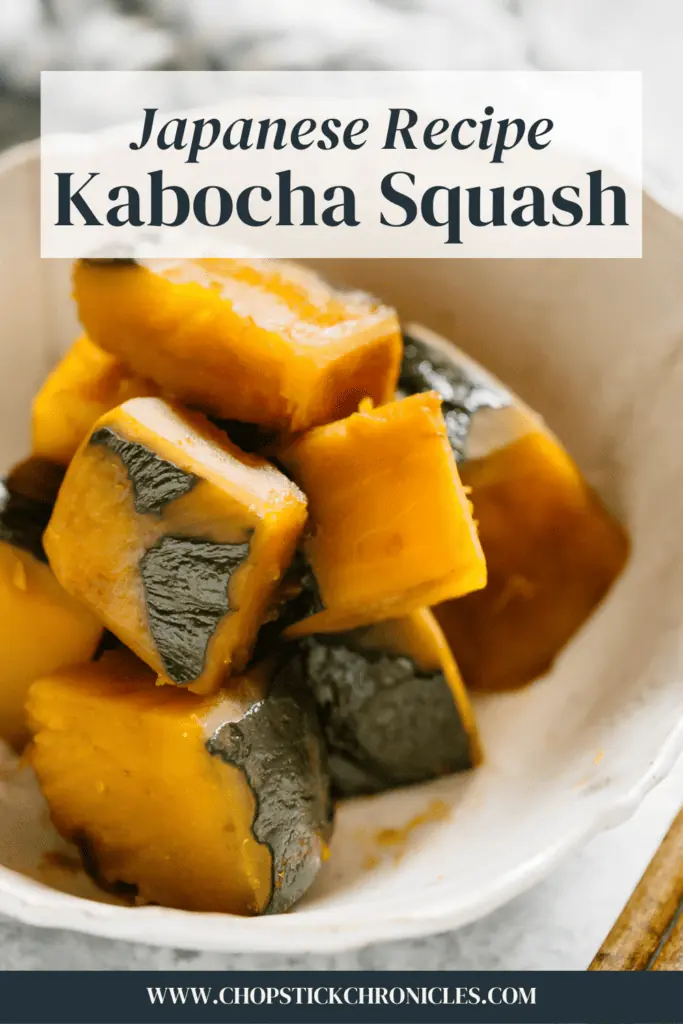
The most typical and easy way to cook pumpkin in Japan is also one of the most delicious. It’s a simple Japanese home-cooking dish called Kabocha no Nimono made from simmering Japanese pumpkin (kabocha squash) in a savoury-sweet dashi broth until tender and flavorful. Kabocha has a naturally sweet and nutty taste, so it really doesn’t need much to make it delicious, just a few simple ingredients and no complicated techniques.
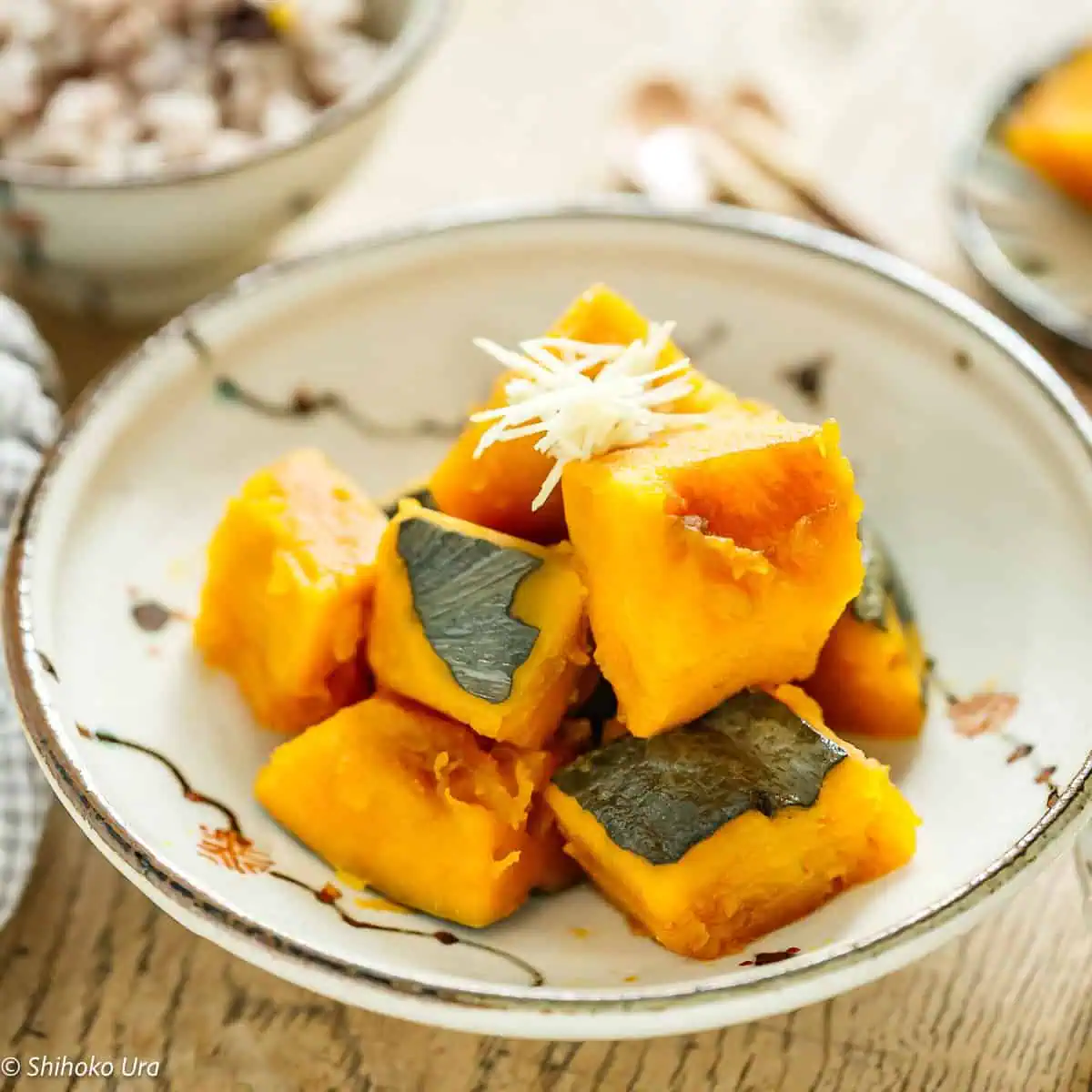
Table of contents
- What is Kabocha Squash?
- How to Pick a Good Kabocha Squash
- What is Kabocha no Nimono?
- Why You’ll Love This Simmered Kabocha Squash
- Ingredients for Making Kabocha no Nimono
- How to Cut and Prepare Kabocha Squash
- Try Mentori
- How to Make Kabocha no Nimono
- What Does Simmered Kabocha Squash Taste Like?
- How to Serve Kabocha no Nimono
- Variations and Substitutions
- How to Store Simmered Kabocha Squash
What is Kabocha Squash?
Kabocha squash is a type of winter squash commonly known as Japanese pumpkin. It has hard dark green skin, orange-yellow flesh, and small seeds inside. Compared with many other types of winter squash, kabocha is sweeter and denser, with a slightly nutty flavor that reminds me of sweet potato and chestnut.
Kabocha is an everyday ingredient in Japanese kitchens. We simmer it for nimono, fry it for tempura, add it to soup and salad, or simply roast it in the oven with olive oil, salt, and pepper. Its naturally sweet flavor works especially well with savory Japanese seasonings.
Kabocha is also a nutritious veggie and a source of fiber, vitamin C, potassium, and antioxidant beta-carotene. I usually cook it with the skin because it is edible, adds color, and helps the soft flesh hold together.

How to Pick a Good Kabocha Squash
With kabocha, the newest squash is not necessarily the sweetest. After harvest, the starch gradually changes into sugar, developing the sweet flavor and fluffy hoku hoku texture we look for in Japan. Choose a kabocha that feels heavy for its size with hard dark green skin and a dry, cork-like stem.
If buying a cut piece, I look for deep orange flesh that appears dense and fairly dry rather than pale or watery.
What is Kabocha no Nimono?
Kabocha no Nimono (かぼちゃの煮物) is a classic Japanese kabocha squash recipe. Nimono means “simmered dish” in Japanese and refers to a cooking technique where vegetables, meat, or fish are gently simmered in a seasoned broth. For this dish, pieces of Japanese pumpkin are simmered in dashi, soy sauce, mirin, and sugar until the flesh becomes tender and absorbs the savory-sweet flavor.
Kabocha no Nimono is a simple dish you will often find in everyday Japanese home cooking. It is served as a side dish with rice and other dishes, and it is also a popular addition to bento because it tastes delicious even at room temperature.
Why You’ll Love This Simmered Kabocha Squash
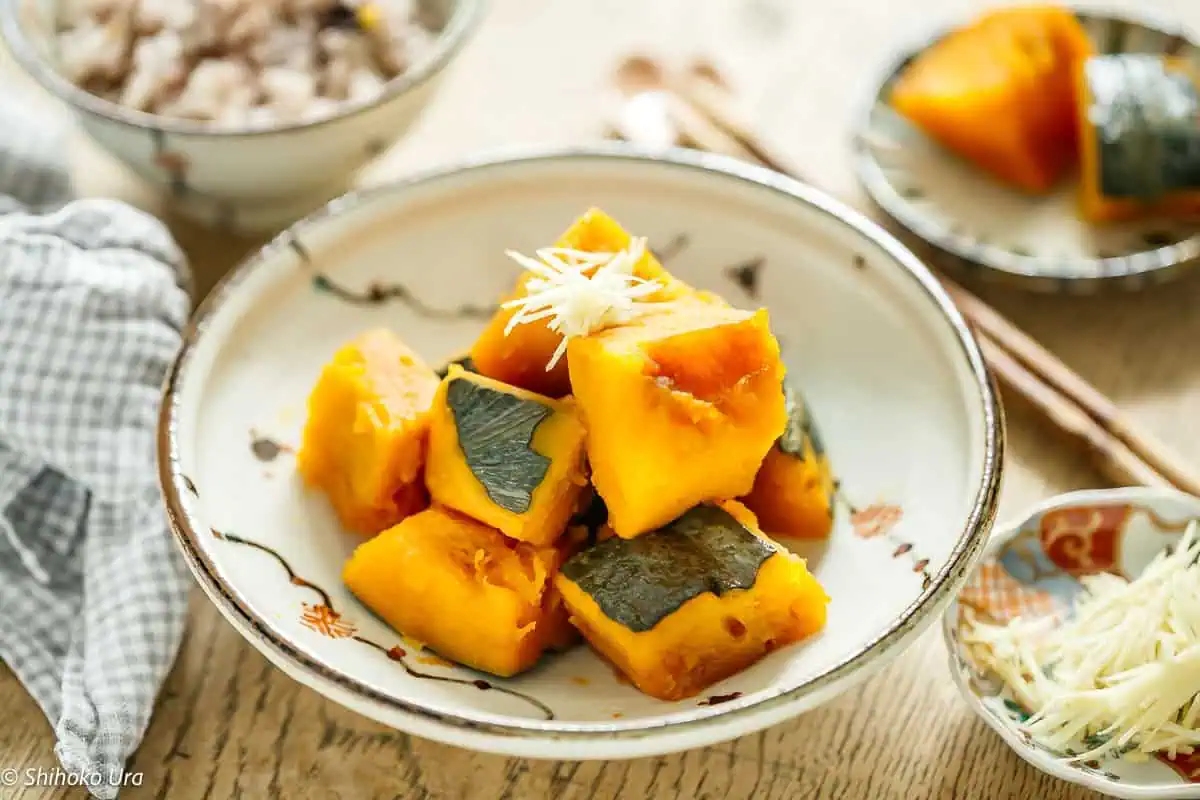
This kabocha squash recipe needs only a handful of Japanese pantry ingredients, but it gives you plenty of flavor. The tender flesh absorbs the savory-sweet broth while the kabocha itself stays naturally sweet and slightly nutty.
It is also one of those dishes I think tastes even better after it has rested. You can make it before preparing the rest of dinner, leave it in the broth, and serve it when the meal is ready. Any leftovers can be kept in an airtight container for another meal or packed into a bento.
Ingredients for Making Kabocha no Nimono
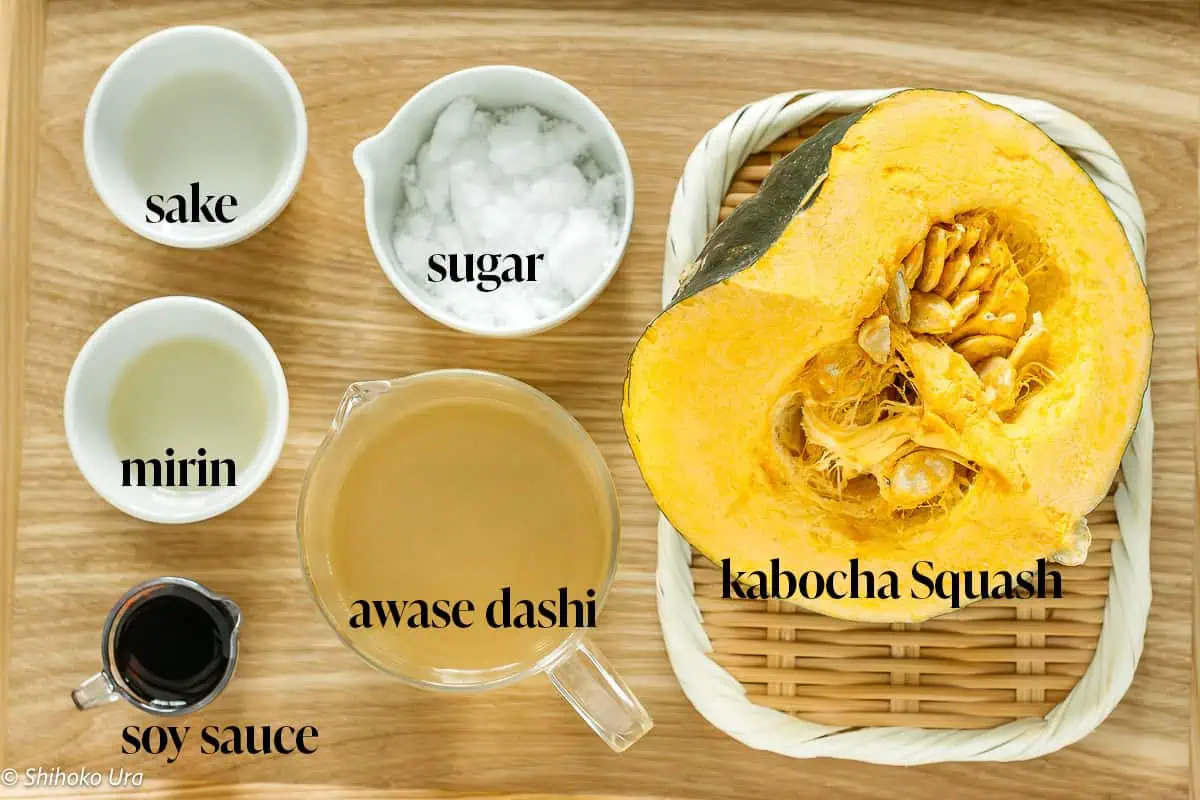
- Kabocha squash : aka Japanese pumpkin. It’s naturally sweet, dense flesh becomes soft and creamy when gently simmered. I like to leave the dark green skin on because it helps the pieces hold their shape while cooking.
- Dashi : Forms the base of the simmering broth and adds plenty of umami without overpowering the natural flavor of the kabocha.
- Soy sauce : Adds saltiness, savory depth, and color to the broth.
- Mirin : Adds a mild sweetness and gives the simmered kabocha a lovely shine.
- Sake : Adds depth to the broth and helps bring all the flavors together.
- Sugar : Balances the soy sauce and enhances the natural sweetness of the kabocha squash.
How to Cut and Prepare Kabocha Squash
Kabocha squash has a very firm skin, so cutting a whole Japanese pumpkin can be tricky. If it is too hard to cut safely, microwave the whole kabocha for about 2 to 3 minutes to soften the skin slightly. Place it on a stable cutting board and use a sharp knife to cut around the stem and carefully cut the squash in half.
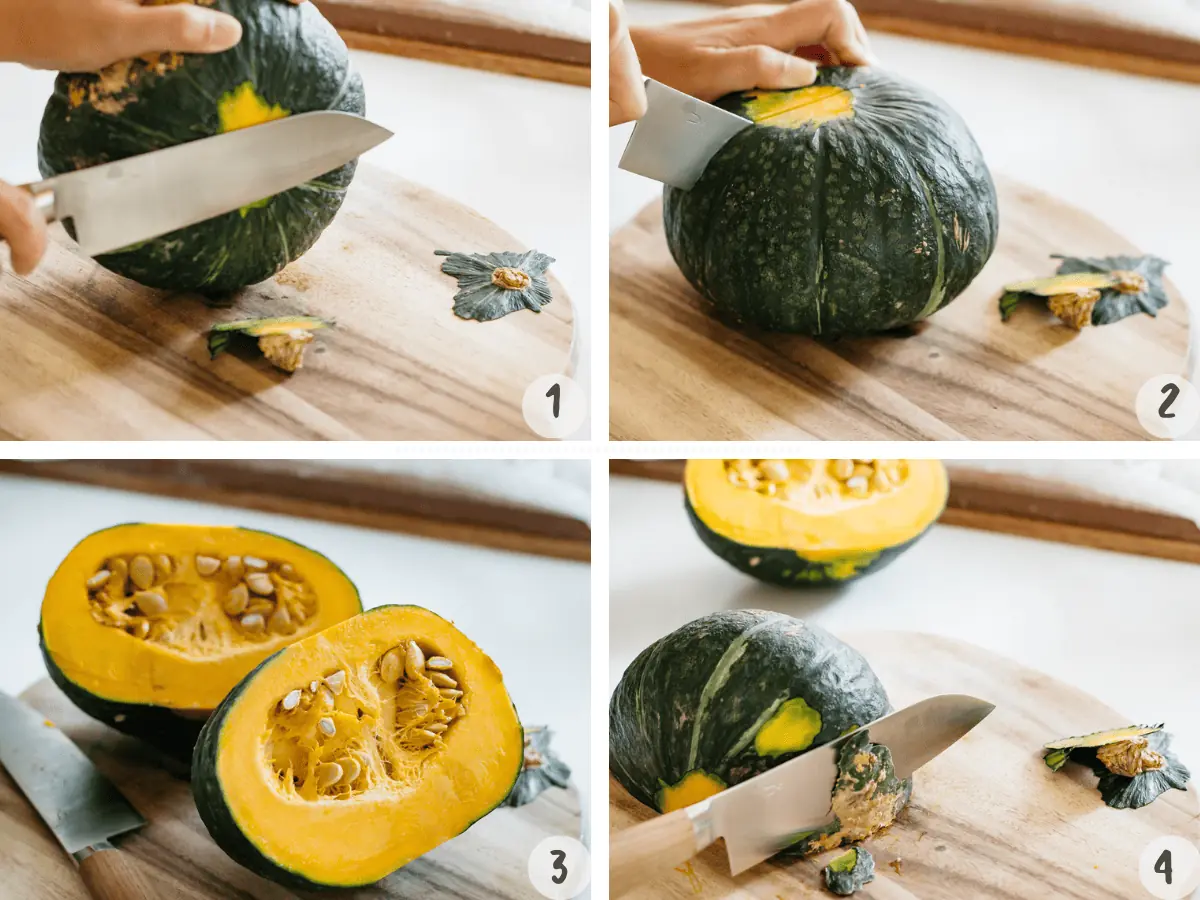
Scoop out the small seeds and stringy center with a spoon. You can save the pumpkin seeds for roasting if you like. Cut the seeded halves into even wedges, then cut them into similar-sized cubes so they cook at the same rate.
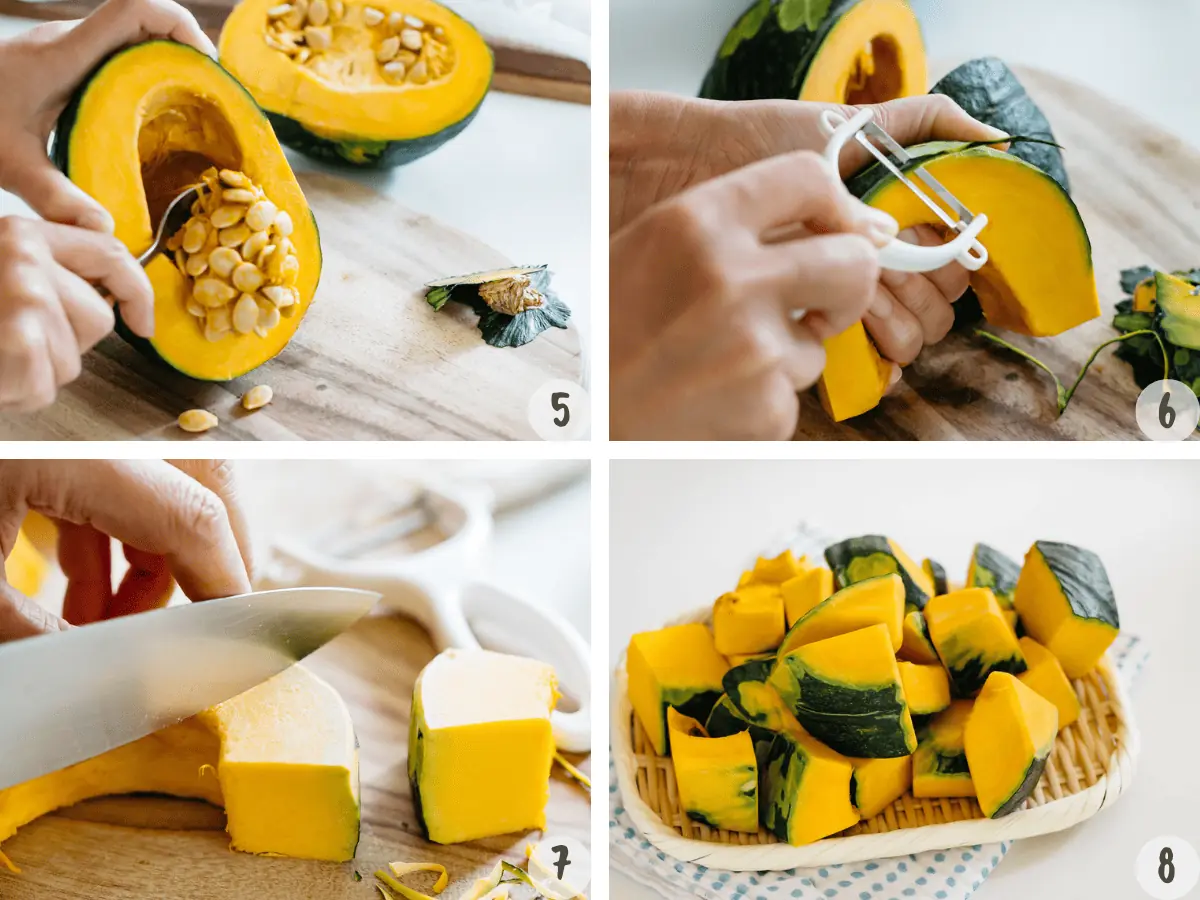
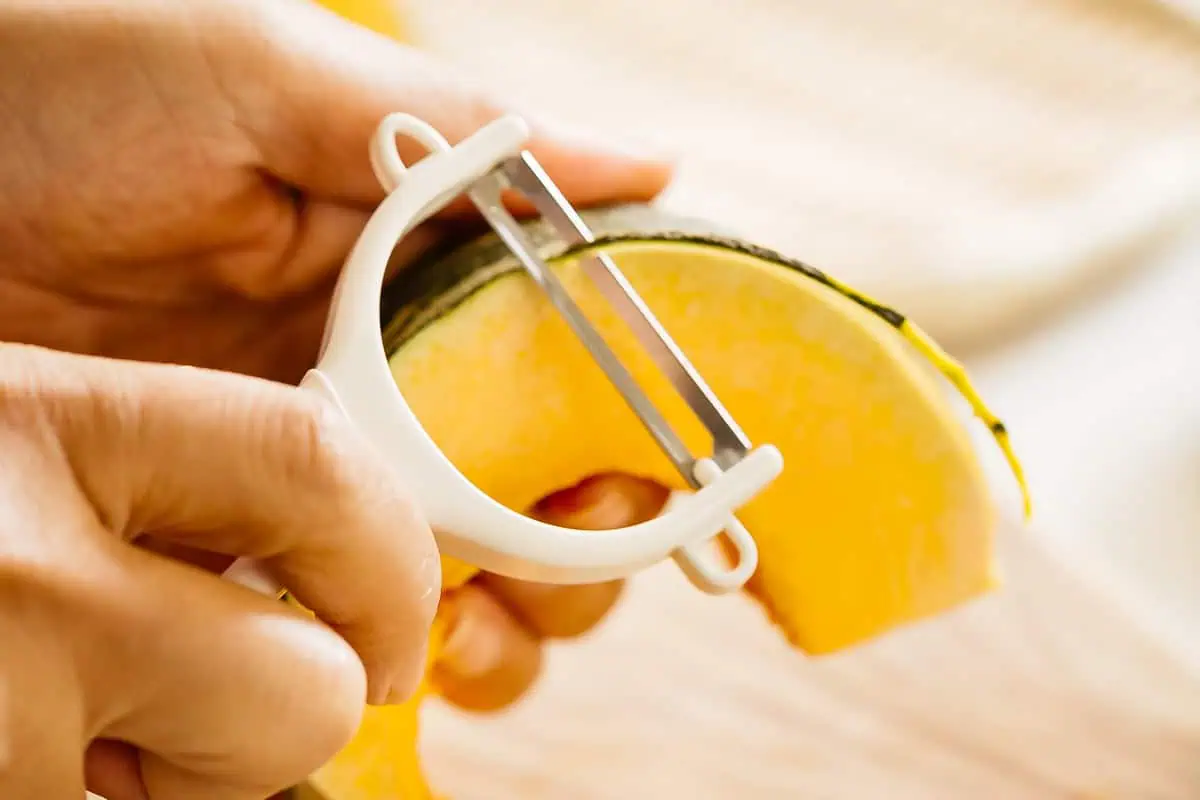
There is no need to peel all of the dark green skin because it is edible and helps the soft flesh hold its shape during simmering. I like to remove small patches of skin from each piece, which also allows the simmering broth to soak into the kabocha better.
Try Mentori
Mentori (面取り) means trimming away the sharp corners of cut vegetables. I use a small knife to lightly shave the edges from each kabocha piece.
It may seem like a small detail, but those sharp corners are the first parts to soften and break away during simmering. Rounding them slightly helps the kabocha stay neat instead of turning the broth cloudy with broken pieces.
How to Make Kabocha no Nimono
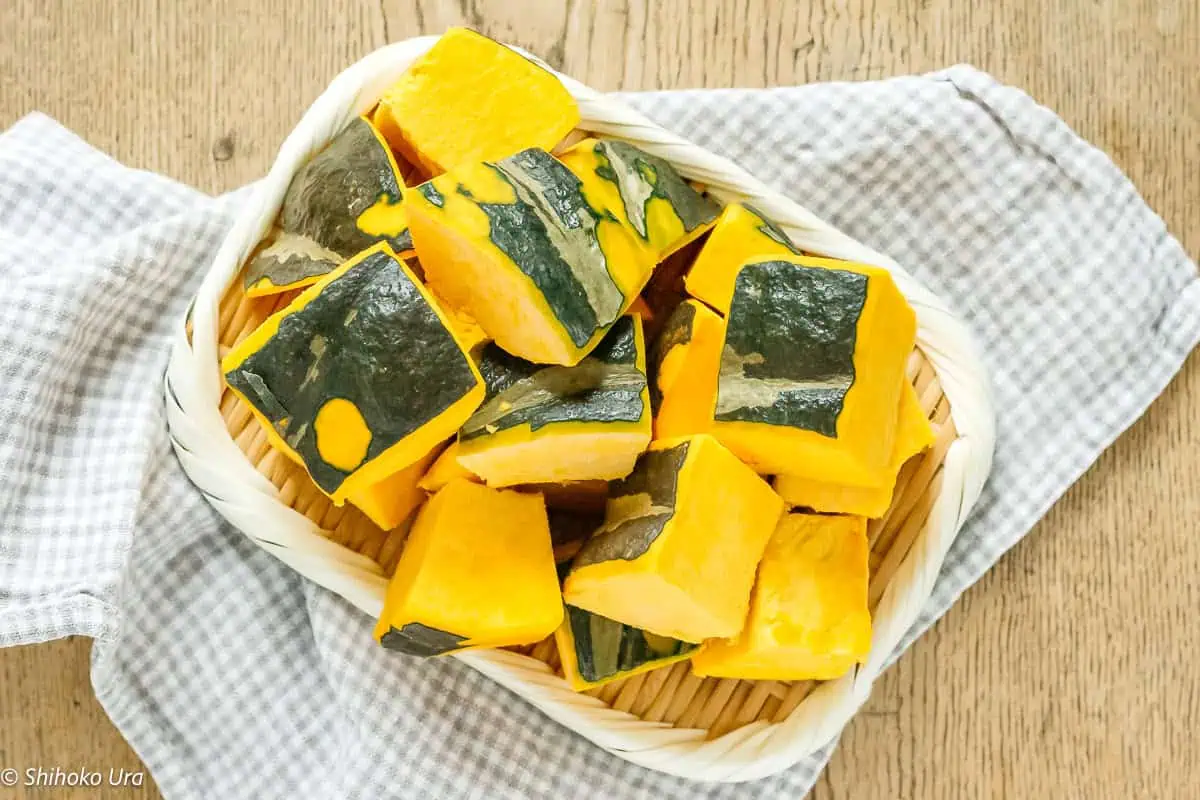
- Prepare the kabocha squash : Cut the kabocha into even pieces as explained above. Keeping the pieces similar in size helps them cook evenly without some becoming too soft.

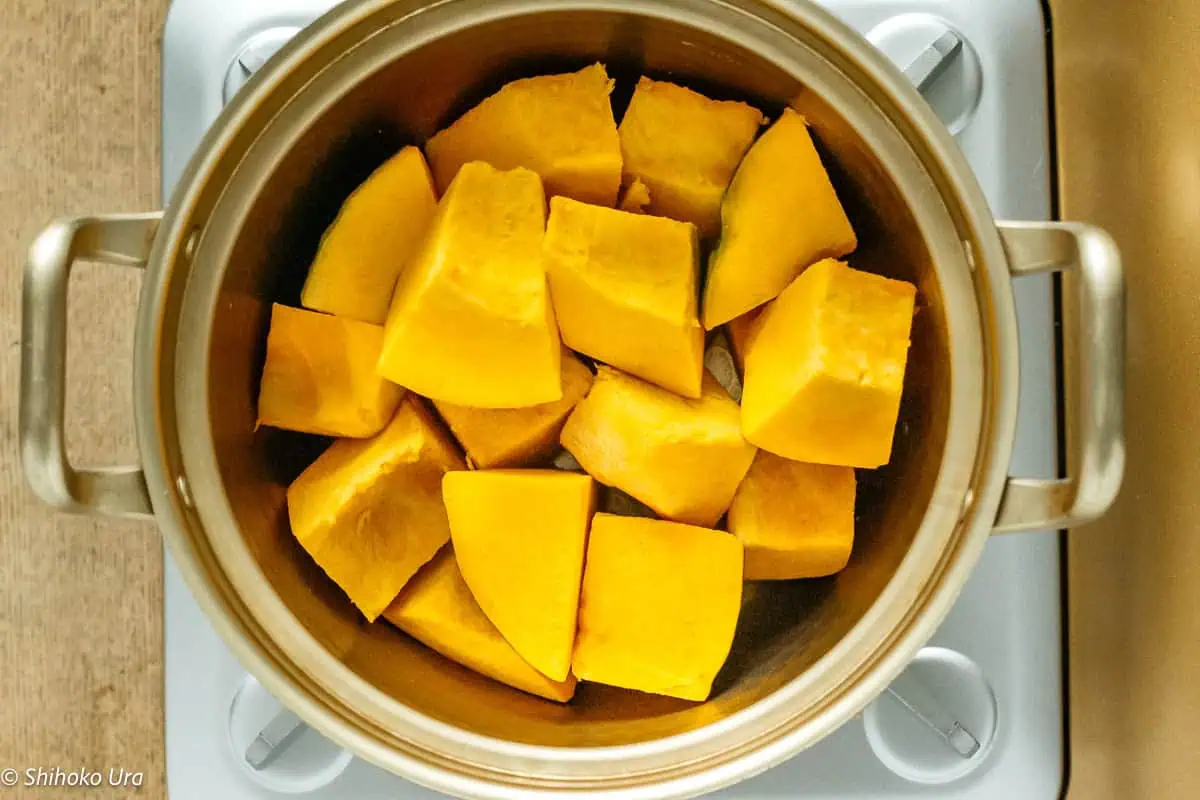
- Arrange the kabocha : Place the kabocha pieces in a saucepan in a single layer with the dark green skin facing down. This helps the tender flesh keep its shape while simmering.
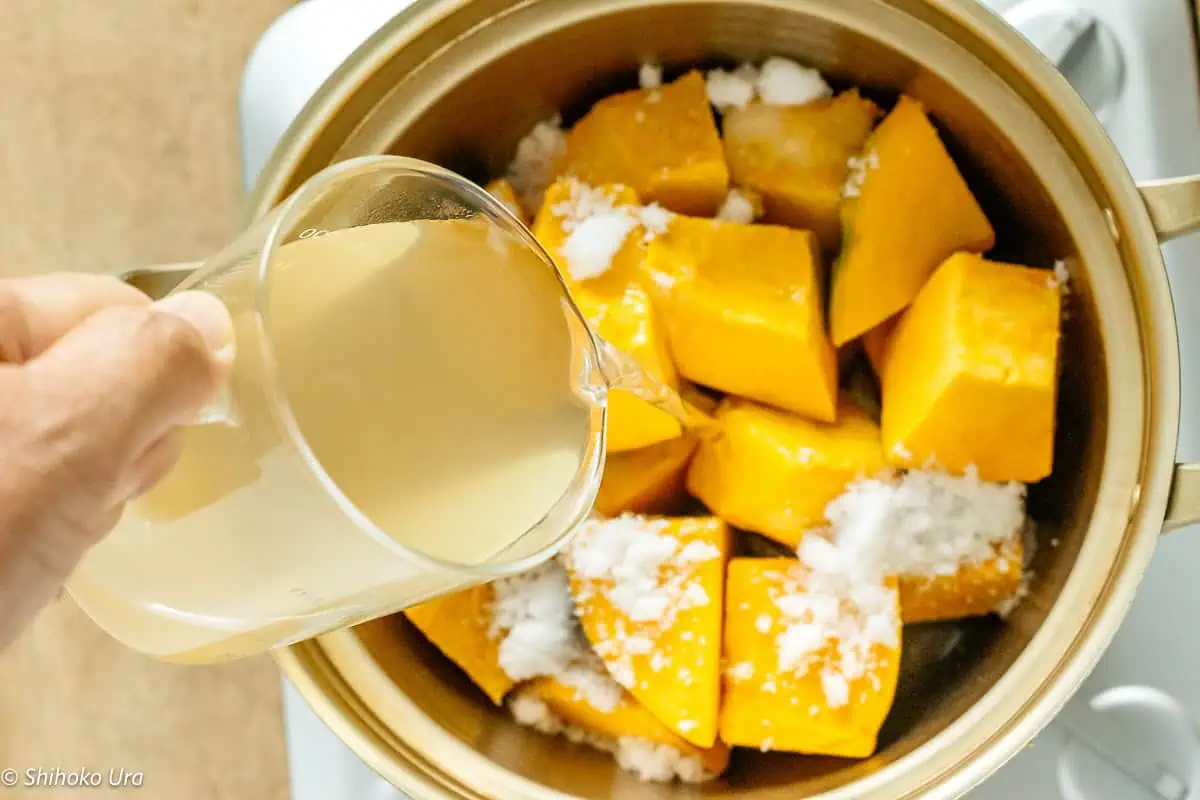
- Add the broth and seasonings: Pour in the dashi, then add the sugar, sake, mirin, and soy sauce. The liquid does not need to completely cover the kabocha.
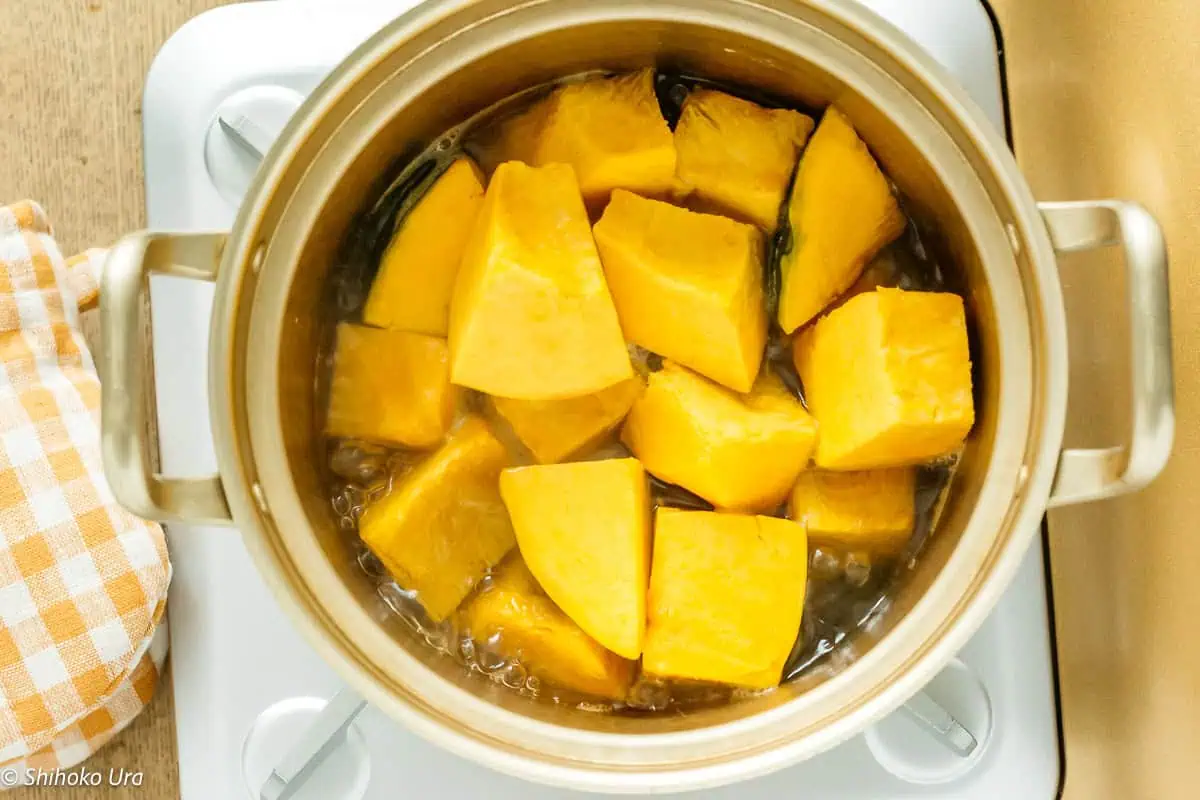
- Bring to a simmer: Place the saucepan over medium heat and bring the seasoned dashi to a gentle simmer.
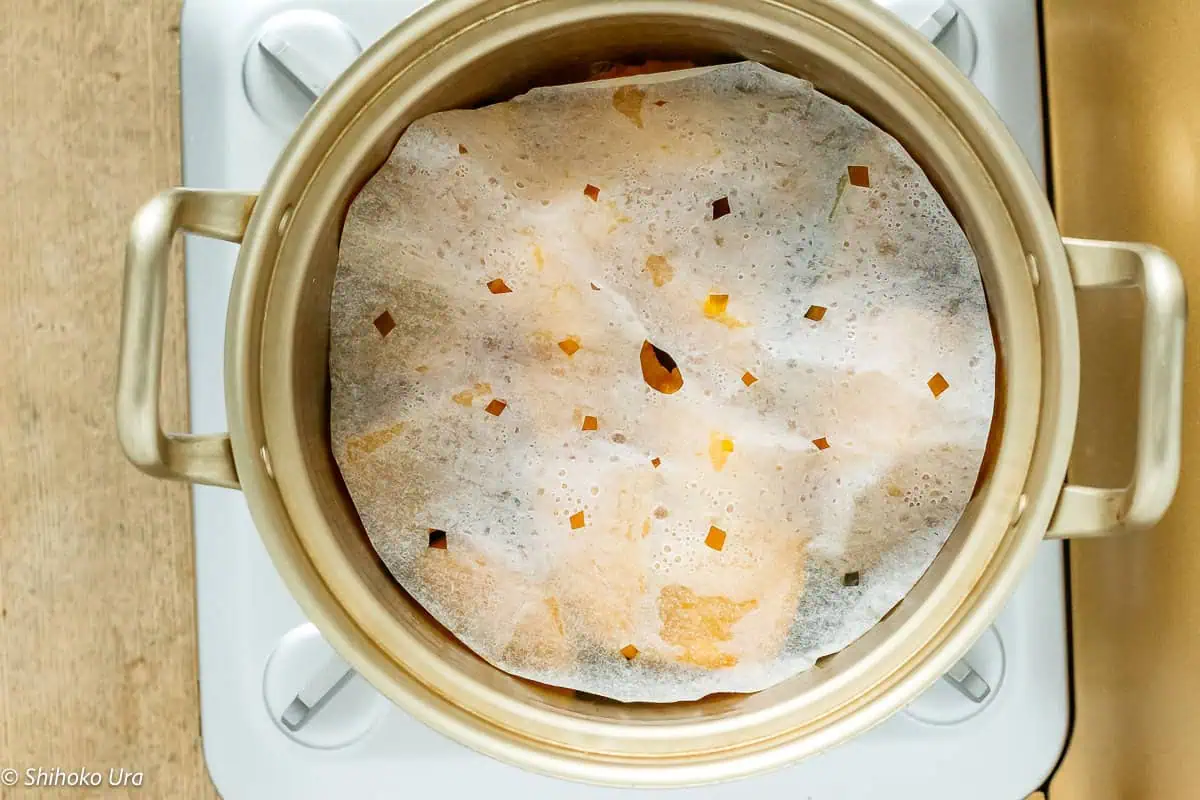
- Cover with an otoshibuta: Place an otoshibuta (drop lid) directly over the kabocha. This helps the simmering broth circulate around the pieces so they cook and absorb the seasoning evenly.
- Simmer gently: Reduce the heat to medium-low and simmer for about 15 minutes, or until the kabocha is tender when pierced with a skewer. Avoid stirring because the soft flesh can easily break apart. Add the soy sauce.
- Let it rest: Remove the saucepan from the heat and leave the kabocha to rest in the broth for about 15 to 20 minutes. As it cools slightly, it will absorb more of the savory-sweet flavor.
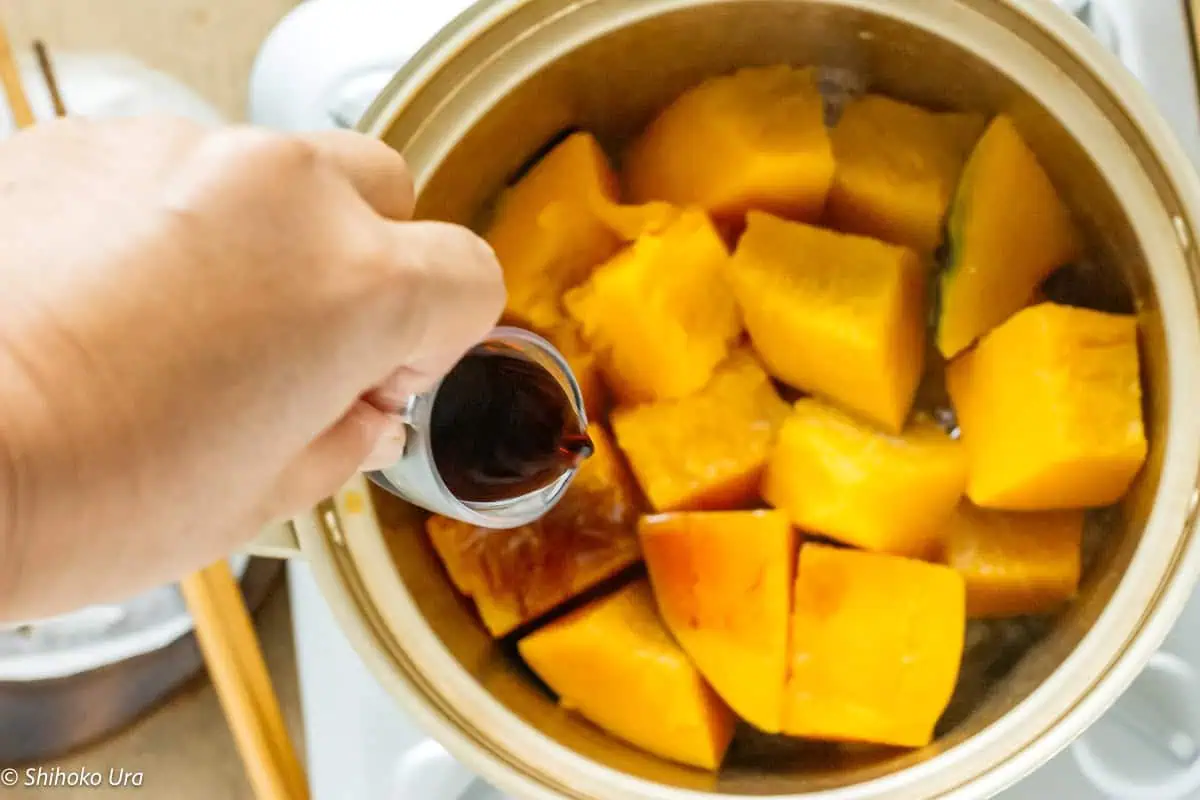
Let the simmered kabocha rest in its broth before serving for the best flavor.
Shiho’s Kitchen tips
Don’t Judge Doneness by Time Alone
15 minutes is a useful guide, but kabocha varies in density and moisture depending on the squash. I start checking with a bamboo skewer near the end of cooking. Stop when the skewer enters easily rather than waiting until the flesh begins breaking around the edges.
Choose a Good Kabocha Squash
When buying a whole kabocha squash, look for one that feels heavy for its size with firm, dark green skin and a dry, cork-like stem. If you are buying pre-cut kabocha, choose pieces with deep orange flesh that looks dense and firm, rather than pale, soft, or watery.
Keep the Kabocha from Falling Apart
Cut the kabocha into even pieces so they become tender at about the same time. I also recommend mentori, which means trimming the sharp edges of each piece to help prevent them from breaking apart. Keep the broth at a gentle simmer and avoid stirring or moving the kabocha unnecessarily because the flesh becomes very delicate as it cooks.
Use an Otoshibuta
An otoshibuta, or Japanese drop lid, sits directly on top of the ingredients rather than at the top of the saucepan. It helps the simmering broth circulate around the kabocha so the pieces cook evenly and absorb the savory-sweet seasoning without needing to be stirred. If you do not have an otoshibuta, you can easily make one from a piece of parchment paper cut slightly smaller than your saucepan.
Let It Rest After Cooking
Do not rush to serve your kabocha as soon as it finishes cooking. Let it rest in the seasoned broth for about 15 to 20 minutes so the pumpkin can absorb even more flavor as it cools. This also makes Kabocha no Nimono a great recipe to prepare ahead of your meal.
What Does Simmered Kabocha Squash Taste Like?
Kabocha squash tastes like a delicious mix of pumpkin, sweet potato, and chestnut, with a naturally sweet and slightly nutty flavor. When simmered, the dense flesh becomes soft and creamy while soaking up the savory, umami-rich dashi and sweet soy sauce broth. Its soft texture and mild sweetness also make this veggie an easy one for children to enjoy.
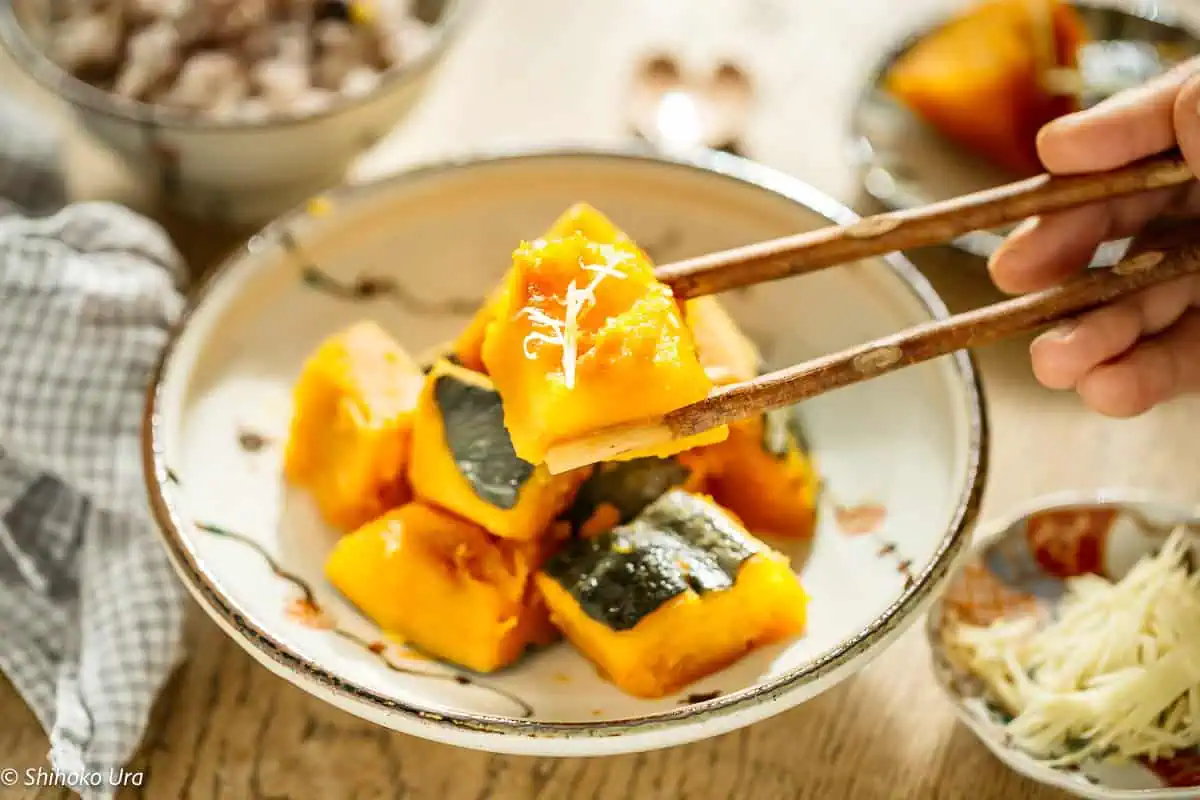
How to Serve Kabocha no Nimono
Kabocha no Nimono is a classic Japanese side dish that fits easily into an everyday meal. Serve the tender kabocha squash with steamed rice and miso soup, alongside grilled fish, chicken, or tofu for a simple and balanced Japanese meal.
This simmered Japanese pumpkin is delicious served warm, at room temperature, or chilled, which also makes it perfect for a Japanese bento. You can even add leftover kabocha to a salad with other veggies for an easy lunch the next day.
Variations and Substitutions
This simple kabocha squash recipe is easy to adjust depending on what you have in your kitchen. For a vegetarian or vegan version, use kombu or shiitake dashi instead of dashi made with bonito flakes.
If you prefer a more savory flavor, reduce the amount of sugar and let the natural sweetness of the Japanese pumpkin shine through. When kabocha is unavailable, you can substitute another sweet winter squash, such as buttercup or butternut squash, although the texture and sweetness will be slightly different.
For a little extra flavour, add a few thin slices of fresh ginger to the simmering broth. It pairs nicely with the sweet squash and savory soy sauce.
How to Store Simmered Kabocha Squash
Let the simmered kabocha squash cool completely, then place the leftovers with a little of the simmering broth in an airtight container. Store it in the refrigerator for up to 3 to 4 days.
You can also freeze Kabocha no Nimono, although the flesh may become slightly softer after thawing. Place the cooled pieces in a freezer-safe airtight container and freeze for up to 1 month, then thaw overnight in the refrigerator.
Kabocha no Nimono is delicious chilled or at room temperature, but you can also gently reheat it in a saucepan over low heat. For a quicker option, use the microwave in short intervals until warmed through, taking care not to overheat the soft kabocha.


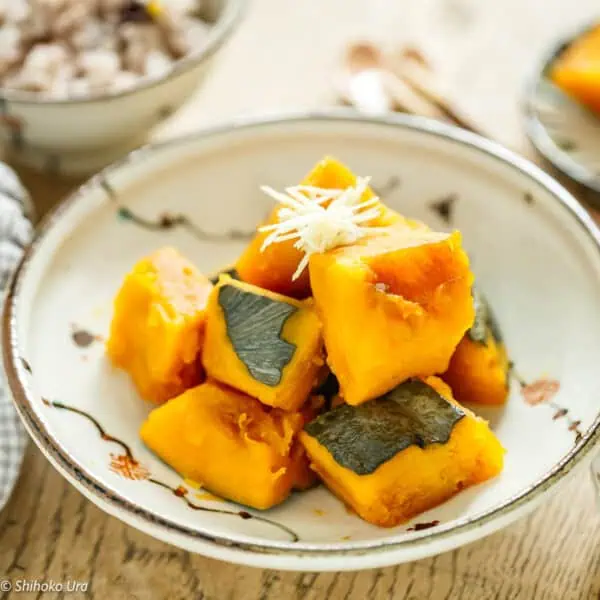
Kabocha no Nimono (Simmered Kabocha Squash) かぼちゃの煮物
Ingredients
- ¼ Kabocha squash pumpkin *1
- 1 cup water
- 2 tbs sugar *2
- 1 tbs sake *3
- 1 tbs mirin *4
- 1 tbs soy sauce
Instructions
- Peel and seed the pumpkin then cut it into even sized chunks.*5
- Round off each corner of the pumpkin pieces. *6
- Lay the cut pumpkin skin side down in a pot without leaving any gaps and without overlapping.
- Add dashi, sugar, sake, and mirin and bring them to boil then turn the heat down to medium heat. Cook about 15 minutes or until the kabocha becomes soft.
- Once it has boiled, turn the heat down to low, and add soy sauce. Put a drop-lid (Otoshibuta) on to the Kabocha pieces directly and simmer for about 5 minutes or until the pumpkin is cooked. *7
- Once it has boiled, turn the heat down to low, and add soy sauce. Put a drop-lid (Otoshibuta) on to the Kabocha pieces directly and simmer for about 10 minutes or until the pumpkin is cooked. *7
- Garnish with chopped ginger. (optional)




Hi, thanks so much for all your recipes – I am new to Japanese cooking.
One query – can I use Kombu Dashi for the simmering here? Your Kombu Dashi recipe says dashi should not be heated over 60 degrees or it will destroy the delicate flavour”?
many thanks
Hi Rachel yes you can 😀
Is this dish ever served cold? Thanks so much!
Hi nadia, yes you can serve it cold. I like it having cold in hot summer. I just had it a couple days ago.
This looks great. I’m not clear on the glaze – do I simmer it in a separate pot, or add all the ingredients to the squash as it cooks? Thanks!
Hi Alison, all ingredients in one pot 😀
Hi……I found this recipe and it’s exactly like the recipe my mother used to make before her passing. I have been making it since.
I was surprised because she used the same term when describing the texture….Hoku Hoku…funny.
By the way what part of Japan are you from……she was from Yamaguchi-ken
Oh thank you so much for your lovely comment. That is exactly I started this blog to share and pass on authentic Japanese recipe who lives outside of Japan and also to my children. I am glad that you found the recipe exactly the way your mom make and I am happy to hear your story. Thank you!! Happy new year. Oh and I am from Wakayama Prefecture.
Thank you for your receipt . I
Trying to find a recipe for the cabocha rice our one vegetarian cafe serves jn LA there is a lot of very tasty cabocha sauce so I
Trying to figure out how to cook that part maybe just blend some pieces of cooked cabocha ? I have a picture of that dish but don’t know how to post it here
I am craving it so bad! I went to farmers
Market and bought a cabocha and wood ear mash rooms for that dish now searching for the recipe
My local grocer always cuts it into small quarters for me if I ask. He’s got this giant, sharp knife that simplifies the cutting up. He also wraps it up in cling film, so I can store it in the fridge and use it when I need to.
Wow Lucky you Samantha!
Love this and love Kabocha…but I find it difficult to get. We are in Qld (Brisbane) also. Are you growing these or are you able to but them?
Hi Marilyn, I get this one at Fuji mart in Bandura shopping complex near Princess Alexandra Hp 😀
My LO would love this! I’m also trying to switch to a healthier lifestyle and started to mine for healthy recipes like yours. Also, I started and manage to get rid of some pounds. Your blog posts are super inspiring for me in this phase, thanks!
Thank you Mara. Hope your switching to healthier lifestyle will be successful with Japanese food.
I loved this recipe! I made the pumpkin to take for lunch in my bento box 😊
Hi Elli, That is fantastic! good idea to take for lunch 😀
Hi Shihoko,
I, too live in Brisbane ( north).
You could find this Kabocha pumpkin in The Global foods market at Woodbridge every Sunday.
Hi Tai!! Really!? OMG Thank you sooooo much for letting me know. I will be there next weekend! I am going to google where Woodbridge is 😀 Thank you!!!
Konichiwa Shihoku-san, my Aunt and grandmother always used to make this recipe with fatty pork chunks. They are unfortunately both passed and I can’t find a recipe uses it in there kabocha recipe. Wondering if you have run into one that does ?
Hi Niki-chan, thank you for reaching out to me 😀 Was it fatty pork chunks? I know one dish commonly made is with ground meat called “Soboro ankake”. I will keep researching 😀
Hi Niki-chan, I think the dish you’re looking for is called “Kakuni”, it’s a recipe that simmers/braises chunks of pork belly in a similar broth (with dashi, soy, sake, mirin, etc…). I hope that’s what you’re looking for.
But with Kabocha?
Hi Niki-chan and Shihoko,
I think the dish you are looking for is :
Simmered Kabocha Pumpkin Soboro.
Oishi! I’ve made this several times and it always turns out great. Cutting the squash is the hardest part!
Thanks!
Thank you Liz for trying this recipe and I am glad that it is “Oishii” 😀 Yes, cutting is hard but it is worth your effort isn’t it?
look delicious!
thank you!
Oh wow, I’ve always loved eating these at Japanese restaurants! I thought it was probably a simple recipe, but for some reason have never bothered to look it up. So thanks for sharing this! This will become a staple in my household, for sure.
PS: Your website and your photography are gorgeous! Such a pleasure to thumb through your recipes. 🙂
Hi Nina, Thank you so much for visiting my blog 😀 I am glad that you like it 😀